Friday, 6 April 2007
More on Tom Dolphin/BMA and MMC

BMA unrepresentative and other news

"Dr Dolphin added: “The concerns of the profession have been ignored really for political reasons and I can’t really defend any of it and I’m not going to try. Obviously things must be pretty bad for a secretary of state to have to apologise and we are hoping things will get better, but it’s still a bit of a disaster." "
Tom Dolphin is attempting to justify the unjustifiable, do junior doctors or even the BMA JDC agree with him here? This is a quote from another member of the JDC:
"I think Tom Dolphin needs to reply to this in defence of his comments. I am a member of JDC and am very unhappy that we were not consulted about the decision to return to the review group. I don't there is likely to be any satisfactory outcome with MTAS in its current form and I would favour a delay and a temporary return to the old CV-based application system which had unlimited entry points. So don't think we all support this move or the decisions the review group make."
So it seems that all the members of the BMA JDC were not consulted about this unfair MTAS fudge. What a representative democracy the BMA is.
Thanks to front point systems for this from the Times. It seems that those at the top of the BMA hierarchy are again not representing the views of their members in their accepting “a practical way forward”, to quote Jonathan Fielden from the BMA.
This is a wonderfully succinct critique of Labour's ugly MMC child by Alex Thomas:
"The transparently jealous attempt to devalue and dis empower the medical profession by this Labour government has been exposed for shambolic outrage that it is. Patients can be glad that we took to the streets in opposition of the appalling sabotage of our training and education. Taxpayers can be glad we protest at the wasting of their money. But will the general public vote with their feet and demand that the government take responsibility for the mess they have created and ensure the future of the medical profession in this country?"
Here, here.
Another HMG wolf, this one eats babies

There has been a large amount of recent attention surrounding Patricia Hewitt's push for more mothers to deliver their babies at home. Maternal mortality in the UK is up 21% in the last three years, and this is progress according to New Labour.
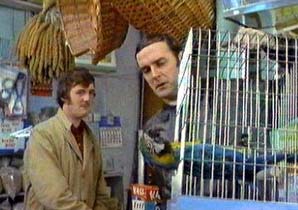
MTAS review panel confronted at last!
(A-applicant, H-head of the review panel, T-train worker)
Applicant: 'Ello, I wish to register a complaint.
(The review panel head does not respond.)
Applicant: 'Ello, Miss?
Head of review panel: What do you mean "miss"?
A: I'm sorry, I have a cold. I wish to make a complaint!
H: We're closin' for lunch.
A: Never mind that, my lad. I wish to complain about this MTAS which I was sold by this very HMG boutique.
H: Oh yes, the, uh, the MTAS scheme...What's,uh...What's wrong with it?
A: I'll tell you what's wrong with it, my lad. 'It's dead, that's what's wrong with it!
H: No, no, it's uh,...it's recovering.
A: Look, matey, I know a dead process when I see one, and I'm looking at one right now.
H: No no it's not dead, it's, it's recoverin'! Remarkable concept, the MTAS scheme, idn'it, ay? Beautiful IT networks, lovely modifications!
A: The IT and modifications don't enter into it. It's stone dead.
H: Nononono, no, no! 'It's recovering!
A: All right then, if 'it's recoverin', I'll wake 'em up!
(shouting at the panel)
'Ello, review panel! I've got a lovely fresh doughnut for you all if you can all prove how...(review panel head shakes desk)
A: There, they moved!
H: No, they didn't, that was you shaking the desk!
A: I never!!
H: Yes, you did!
A: I never, never did anything...
H: (yelling and hitting the desk repeatedly) 'ELLO PANEL!!!!!
Testing! Testing! Testing! Testing! This is your nine o'clock alarm call!
(Walks around the room and slaps each member of the review panel around the face while waiting for their justification of MTAS.)
A: Now that's what I call a dead process.
H: No, no.....No, they're stunned!
A: STUNNED?!?
H: Yeah! You stunned them, just as they was wakin' up! Review panels stun easily, sir.
A: Um...now look...now look, mate, I've definitely 'ad enough of this. That MTAS process is definitely deceased, and when I started this not three months ago, you assured me that its total lack of working was due to it bein' tired and shagged out following a tricky birth.
H: Well, he's...it's, ah...probably pining for a holiday.
A: PININ' for a HOLIDAY?!?!?!? What kind of talk is that?, look, why did it crash straight away the moment I got him home?
H: The MTAS system needs regular breaks! Remarkable system, id'nit, squire? Lovely networks!
A: Look, I took the liberty of examining that process when I got it home, and I discovered the only reason that it had been forced upon us in the first place was that it had been NAILED there by HMG.
(pause)
H: Well, o'course it was nailed there! If I hadn't nailed the thing down, it would have escaped from the MTAS headquarters using its artifical intellignece, and VOOM! Feeweeweewee!
A: "VOOM"?!? Mate, this MTAS wouldn't "voom" if you put four million volts through it! 'It's bleedin' demised!
H: No no! It's pining!
A: It's not pinin'! It's passed on! This process is no more! It has ceased to be! It's expired and gone to meet 'is maker!
It's a stiff! Bereft of life, It rests in peace! If you hadn't nailed it to the MTAS headquarters it'd be pushing up the daisies!It's metabolic processes are now 'istory! It's off the twig!It's kicked the bucket, It's shuffled off its mortal coil, run down the curtain and joined the bleedin' choir invisibile!!
THIS IS AN EX-PROCESS!!
(pause)
H: Well, I'd better replace it, then.
(he takes a quick peek behind the desks)
H: Sorry squire, I've had a look 'round the back of the desk, and uh, we're right out of application processes.
A: I see. I see, I get the picture.
H: I got a modernsing medical careers.
(pause)
A: (sweet as sugar) Pray, does it work?
H: Nnnnot really.
A: WELL IT'S HARDLY A BLOODY REPLACEMENT, IS IT?!!???!!?
H: Look, if you go to my brother's review panel meeting in Hull, he'll get it working for you.
A: Hull, eh? Very well.
The customer leaves.
The customer enters the same review panel meeting. The review panel head is putting on a false moustache.
A: This is Hull, is it?
H: (with a fake mustache) No, it's Liverpool.
A: (looking at the camera) That's Virgin trains for you.
The customer goes to the train station.
He addresses a man standing behind a desk marked "Complaints".
A: I wish to complain, Virgin trains person.
Attendant: I DON'T HAVE TO DO THIS JOB, YOU KNOW!!!
H: I beg your pardon...?
T: I'm a qualified brain surgeon! I only do this job because I like being my own boss!
A: Excuse me, this is irrelevant, isn't it?
T: Yeah, well it's not easy to pad these copied python files out to 200 lines, you know.
A: Well, I wish to complain. I got on the Hull train and found myself deposited here in Liverpool.
T: No, this is Hull.
A: (to the camera) The review panel head's brother was lying!!
T: Can't blame Virgin trains for that.
A: In that case, I shall return to the review panel meeting!
He does.
A: I understand this IS Hull.
H: (still with the fake mustache) Yes?
A: You told me it was Liverpool!
H: ...It was a pun.
A: (pause) A PUN?!?
H: No, no...not a pun...What's that thing that spells the same backwards as forwards?
A: (Long pause) A palindrome...?
H: Yeah, that's it!
A: It's not a palindrome! The palindrome of "Hull" would be "Lluh"!! It don't work!!
H: Well, what do you want?
A: I'm not prepared to pursue my line of inquiry any longer as I think this is getting too silly!
Sergeant-Major: Quite agree, quite agree, too silly, far too silly...

Thursday, 5 April 2007
Is the MTAS parrot dead yet?
I am sure John Cleese could come up with a very humorous sketch concerning the MTAS scheme, there is certainly no shortage of ammunition with which to attack the deeply flawed process. There is a very valid comparison to make between the Monty Python parrot and the MTAS process as both are very much dead, but there are people insisting that they are very much alive. Here is yet another nail in the MTAS coffin:"Professor Sir Liam Donaldson
This is another damning account of how MTAS has been an undisputed failure. Prof Heard is amazingly critical of the role of the review group, saying that they have not modified things 'strategically or with an eye on the future'. She also states that the review group's amended process is not equitable, another key detail in her letter I feel.
How can the MTAS process be allowed to continue when it is clearly not fair or equitable for all the doctors involved? The review panel is now giving an unfair advantage to candidates who benefited from the initial short listing process;when even they had conceded that the short listing process was next to useless!
This excellent letter from Group of Anaesthetists in Training (GAT) tells the review group what trainees really think of their diabolical fudge.
I was thinking of penning a letter to the review group myself but decided against it in the end, Dark Place hospital could not do without me if I was struck off by the GMC for telling it like it is:
Dear review panel,
You must all resign immediately as you are an bunch of utter c*nts,
kind regards,
Garth
How many nails in the coffin will it take before the MTAS corpse is declared well and truly dead? Do the review group think Elvis lives on? Are they the kind of people that keep their dead grannies at home long after they have passed away, in a state of denial that their cherish one is no longer living? Should the review panel be sectioned under the mental health act, or should they be given control orders due to the acts of state terrorism that they have carried out in their quest for knighthoods? They really are a jolly bad bunch of eggs and I am going slightly loopy as a result of having to endure months of this sick and twisted comedy tale.
Wednesday, 4 April 2007
Absolute farce continues

The 'independent' review panel has declared its divine judgement on the MTAS process here. Their judgement is nothing but a very bad joke. One must note that the review panel has already admitted that the short listing process is next to useless.
Their final fudge means that all interviews that have already taken place will stand. This means that candidates who were short listed for four interviews are at a massive advantage over those with no initial interviews. However, as the short listing was an unvalidated sham, those candidates with four interviews are not necessarily any better than those who initially had no interviews; this means that the system is now completely unfair, as it hands an unfair advantage to a certain group of candidates.
If this process is deemed to be fair and legal, I really fear for the future of selection. It is simply ridiculous that the review panel can admit the short listing process is next to useless one week, but the next week they hand the candidates who have been fortunate with the short listing process a massively unfair advantage.
The members of the review panel must have short circuited their logic circuits with all the thought of the knighthoods that they are to shortly receieve for their betrayal of the medical profession. Do these people have no shame?
Legends speak out

This is taken from the Times letters section:
"Time to junk the appointments system for doctors
Sir, The chaos of the new appointments system for junior doctors, which left one third without interviews at the beginning of March, returned to the news with the resignation of Alan Crockard (report, March 31 ) from his position in the Department of Health as principal architect of the attempt at Modernising Medical Careers (MMC). “From my point of view, this project has lacked clear leadership from the top for a very long time,” he says in his resignation letter. His departure and Parthian letter appear to hole beneath the waterline the edifice he created, and underline the folly of senior doctors struggling to keep it afloat by “following orders”. Whose orders?
We recognise the need for evolutionary changes in medical training, always adapting to patient need and taking into account changes in supply and demand for doctors in the UK and Europe.
However, there are two principles that cannot be compromised. One is that entry into specialty training programmes is based on the use of objective criteria which recognise scholarly and clinical achievement. The other is flexibility in training programmes, so that patients do not find themselves cared for by disillusioned doctors working in specialties for which they lack enthusiasm or aptitude.
MMC enforces premature choices by doctors only two years out of medical school, and expects candidates to sign over five critical years of their career without being told the detailed specification or location of the training and mentorship they will receive.
As for the much trumpeted concept of MMC as saviour of “the lost tribe” of senior house officers (SHOs) — the group of doctors two to four years postqualification — salvation seems hard to square with the random carnage of at least 8,000 doctors, mainly SHOs, who will shortly drop out of the NHS after costing the taxpayer £2 billion to train to their present level.
The legality of restricting the number of job applications for specialist training posts is being seriously questioned. Remarkably, the review body established in early March is seeking to impose a reduction in choice from the four that were advertised to just one interview per candidate. Because the preinterview shortlisting process has been abandoned (after costing tens of millions of pounds), more taxpayers’ money is to be thrown at interviewing all applicants without selection, including the possibility of repeating under new rules thousands of interviews already conducted.
The royal colleges recognise the burden this places on consultants and trusts, including cancellation of clinical activities that are bound to have adverse effects on patient care. In every poll conducted, more than 80 per cent of several thousand doctors have declared against continuation of the new Medical Training Application System (MTAS), in favour of an immediate return to the previous selection system for this year. If the review body will not listen, this is the week for grassroots democracy to act. MTAS cannot progress without participation by individual consultants in interviews. We hope they will say no, that individual trusts will ballot their consultants, and that medical directors and chief executives, putting patient care first, will say no.
We urge, instead, an immediate return to a regionally based appointments system led by the same expert doctors as will be responsible for the specialist training. This solution is still feasible; it will minimise the adverse impact of the hugely expensive and ill-considered reorganisation on patient care, while providing much needed breathing space for careful planning and validation of new training and appointment processes.
MORRIS BROWN, Professor of Clinical Pharmacology, University of Cambridge
JOHN CAMM, Professor of Clinical Cardiology, St. George's Hospital Medical School
MARK CAULFIELD, Professor of Clinical Pharmacology, Queen Mary College, London
PAUL CORRIS, Professor of Thoracic Medicine, University of Newcastle
EDWIN CHILVERS, Professor of Respiratory Medicine, University of Cambridge
PAMELA EWAN, Consultant Physician, Addenbrookes Hospital
JOHN GIBSON, Professor of Respiratory Medicine, University of Newcastle
GEORGE GRIFFIN, Professor of Infectious Diseases and Medicine, Chairman of Association of Clinical Professors of Medicine
ASHLEY GROSSMAN, Professor of Endocrinology, Queen Mary, University of London
ALISTAIR HALL, Professor of Clinical Cardiology, University of Leeds
GEORGE HART, Professor of Medicine, University of Liverpool
TONY HEAGERTY, Professor of Medicine, University of Manchester
HUMPHREY HODGSON, Vice-Dean, Royal Free and University College School of Medicine
PHILIP HOME, Professor of Diabetic Endocrinology, University of Newcastle
RICHARD HUGHES, Professor of Neurology, Kings College London
KAY-TEE KHAW, Professor of Clinical Gerontology, University of Cambridge
JOHN LAZARUS, Professor of Clinical Endocrinology, University of Cardiff
JOHN MONSON, Professor of Surgery, University of Hull
STEPHEN O’RAHILLY, FRS, Professor of Clinical Biochemistry, University of Cambridge
BRIAN ROWLANDS, Professor of Surgery, University of Nottingham
NEIL SCOLDING, Professor of Neurology, University of Bristol
ROBERT SUTTON, Professsor of Surgery, University of Liverpool
ROY TAYLOR, Professsor of Medicine & Metabolism, University of Newcastle
NICK WRIGHT, Warden, Queen Mary College, London"
Very well said gentleman. It appears that each of these chaps has more integrity than the whole of the review group combined. This is on a day when the BMA rejoined the group that they had previously withdrawn from, so much for taking a stand.
It is verging on the disgusting that the likes of Jo Hillbourne can think that juniors are happy with the compromise and that 'a crisis has been averted'. This is a lie and she is not representing the views of her members, therefore I see only one path that she can logically take.
It is sad that the control of medicine and medical education has been taken away from the brilliant individuals like Morris Brown by the political incompetents like Sir Liam. It is thanks to this new politicised hierarchy that common sense has been chucked out of the window, and replaced with steaming faeculent matter such as MTAS.
Shame on this politicised breed of moron, the only option they have left is to resign and hand control back to those with the real know how. Unfortunately they are not a noble breed of man, and this means their hand will have to be forced. However it appears that the grass roots of the medical profession have more than enough hunger to overthrow their greedy lords of the manor; just so long as they do not become complacent, this may well be achieved.
Tuesday, 3 April 2007
RCS President not hopeful for the MTAS beast

"I have attempted over recent weeks to keep you fully informed and up to
date as discussions have proceeded about the debacle caused by the MTAS
arrangements and the steps that have been taken by the review group with
a view to resolving this.
This is a very complex issue. It has been clear from the outset that
the arrangements have broadly served general practice well while the
position with hospital medicine has been much less satisfactory. Across
various specialties and in some deaneries, there has been recognition
that good candidates have been selected for, and performed well in,
interviews. Elsewhere, however, it has been clear that well qualified
and experienced candidates have not been identified. The prevailing
view in surgery is that the arrangements are seriously flawed. Our
survey of Fellows and Members, with about 80% of respondents considering
MTAS so fundamentally flawed that it is incapable of continued operation
and should be abandoned for 2007 with a return to the deanery
appointment processes that were in place last year, was a significant
indicator. The recent ASIT meeting in Belfast, where I could gauge the
views of a significant number of trainees, reconfirmed this widespread
dissatisfaction. There was some feeling that an extension of choice to
applicants, to be interviewed for two or more of their MTAS selections,
would improve matters but there remain grave logistical concerns that
this is impractical. The Scottish Executive announced on 30 March 2007
that "eligible junior doctors applying for specialty training jobs will
be offered interviews for all posts applied to in Scotland". It has
been particularly unhelpful that a lack of coherent and consistent
thinking amongst ministers and officials in Edinburgh, Cardiff and
London has led to an utterly inequitable situation where trainees in
parts of the United Kingdom appear to have been offered multiple
interviews against their preferred choices while others will not, or
cannot, be treated on a similar basis.
There will be a further meeting of the review group tomorrow and I will
attend once more to outline my grave concerns about the general
situation and these recent developments and to assess whether there is
any prospect of finding a satisfactory solution. I have to say that I
am not optimistic and I assure you that I will dissociate myself from
these negotiations if I see no recognition of the gravity of the
situation generally, and particularly for surgery. There must be
adequate transitional arrangements put in place to support those able
trainees who fail to be appointed at this stage. I will not see a
generation of highly qualified, experienced and committed surgical
trainees exposed to the vagaries of an untested and clearly flawed
system, effectively participating in a professional lottery.
I will write to all of you again following this meeting tomorrow.
Having acted until now in what I believe to have been the best
interests of everyone, given the range of opinions I have heard and the
practical constraints of which I have been conscious, I am not prepared
to leave you, and those who share your concerns, in further uncertainty.
If there is no significant and expeditious move tomorrow towards a
satisfactory solution, I and my colleagues on Council will seek,
independently if necessary, a resolution of this situation that meets
now your reasonable expectations and ensures for the longer term our
patients' absolute right to the safest and highest-quality care.
Bernard Ribeiro CBE
President"
If this well informed man is 'not optimistic' of finding a 'satisfactory solution', then what hope do trainees have of a fair and satisfactory outcome?
Not much it would appear, unless the obstinate fools in the review panel stop living in denial and scrap this god forsaken scheme.
Nurse prescribers 'flounder'

This is taken from the latest of the GP magazine Pulse:
"Nurses are 'floundering' in their new prescribing role
| Issue: 29 March 2007 Section: News |
The analysis bears out doctors' worst fears over nurse independent prescribing after last year's controversial decision to award nurses access to the entire BNF, writes Daniel Cressey. The majority of trained nurse prescribers scored zero points on tasks set to assess their clinical problem-solving abilities, and few were able to identify key problems in clinical scenarios or provide 'acceptable solutions'.
It follows a Pulse survey conducted last year with Doctors.net.uk, which found 89 per cent of doctors believed the new regulations on nurse prescribing were not adequate to protect patients. Study leader Dr Maxine Offredy, reader in primary health care at the University of Hertfordshire, said nurses were 'perhaps knowledgeable in their small area of practice but flounder outside this'. 'We demonstrated lack of appropriate pharmacological knowledge coupled with lack of confidence in prescribing,' she added. Carried out over two PCTs, the study involved 18 qualified nurse prescribers and seven nurses undertaking a prescribing course. All had a minimum of eight years' experience in their area of practice. The majority were 'unable to identify the issues' involved in the four scenarios and 'failed to provide an acceptable solution to the problem'. Only six participants provided a full, correct response to the first scenario and performance was even worse on the other three (see below). In interviews, one nurse criticised her training on pharmacology as 'really awful'. Around half of participants scored zero points out of three in each of the scenarios tested.
Dr James Kingsland, a GP in Merseyside who trains nurse prescribers, warned: 'There's a big difference between nurse prescribers and nurse diagnosticians. When a treatment plan hasn't been drawn up and they're left with uncertainty then you're moving into areas nurses are not trained for.' Dr Nigel Watson, chief executive of Wessex LMCs, said: 'It confirms what many of us thought. I struggle with the idea that everybody can do our job better than we can.' "
There is currently a consultation up and running here that wants to give nurses and pharmacists the right to prescribe controlled drugs.
'This letter seeks your views on the proposals to expand the range of Controlled Drugs that can be prescribed independently by Nurse Independent Prescribers and to enable Pharmacist Independent Prescribers to independently prescribe Controlled Drugs. It also seeks your views on whether nurse and pharmacist prescribers should be allowed to prescribe specific Schedule 2 drugs to addicts for the management of their addiction.'
E-mail:
ConsultationNIPSandPIPS@homeoffice.gsi.gov.uk
"To amend the Misuse of Drugs Regulations 2001 to allow the
independent prescribing of any Controlled Drugs from Schedules 2,3,4
and 5 of the 2001 Regulations by Nurse Independent Prescribers and
Pharmacist Independent Prescribers. (Para. 18)
A. I support the proposal.
B. I have no comment to make on the proposal.
C. My comments on the proposal are below/attached."
Amazingly there is no way option here of opposing the proposals! I presume this is a deliberate tactic for the future spinning of the consultation results, this will done by lumping abstainers and dissenters into a meaningless merged conglomerate and brushing opposition under the carpet as it were.
Given that there was no decent evidence that nurse and pharmacist prescribers could adequately diagnose and prescribe in the first place, it is nothing but outright dangerous to hand these groups the right to prescribe controlled drugs.
Not only will they flounder, but they will harm untold numbers of patients during this floundering process. And its all done in the name of patient safety, twisted DoH logic again.
Monday, 2 April 2007
Fly away on your broom Patsy

Andrew Lansley MP has written to Patricia Hewitt and asked her some specific questions as regards her recent answers to parliamentary questions on MMC. Some clever chap has obviously pointed out several factual flaws in Patrica Hewitt's rather flimsy argument:
"
The mighty Dr Rant has some lovely things to say about our Patricia, she really has done some fine things for young mothers in this country.
While on the radio 4 today programme she did eventually apologise for the MTAS fiasco, albeit about two months late, but she didn't miss the chance to say 'everyone thinks that MMC is a good idea'. Its quite amazing how the patronising woman feels she can still spin her disastrous policies as being loved by the profession, she truly has no shame.
Take to your wicked broomstick and fly, fly far away from the land of the NHS and take your evil potions with you.
PMETB letter - have it!

"Dear Professor Rubin,
It is with great concern that I write to you in your capacity as chairman of PMETB. The scale of the crisis facing trainee doctors, and indeed the NHS as a whole is beginning to become apparent. This, of course, relates to the catastrophic failure of the MMC admission process run via MTAS.
I have read with interest the statement made by PMETB on the 19th March. It is clear that PMETB also have serious concerns with this process and are closely watching developments.
I learnt of the resignation of the National Director of MMC last Friday. In his resignation statement Professor Crockard makes it clear that he believes the current compromise solution adopted by the MMC review group to be unfair to applicants, and raises the question that this compromised process might run contrary to employment law. Indeed, a legal challenge has been launched by RemedyUK on behalf of trainee doctors. This seeks to question the legality of the compromise solution currently in place.
In addition, I have also read with interest the letter from PMETB to CoPMED dated 21/9/06 which followed a presentation given by CoPMED regarding the arrangements for recruitment into specialty training. PMETB clearly state that a presentation was made by Professor Patterson regarding the methodology of selection. It is now clear that her research is highly questionable and many have expressed serious reservations that such limited evidence should be used to design such an important selection process. Not least, such selection methodology has been met with ridicule by many consultants experienced in shortlisting and interviewing for junior doctor posts.
In this letter, PMETB make their role clear; the conclusion of the letter reading:
‘…these proposals, evaluation of which will, in due course, form a part of PMETB’s quality assurance work as the regulatory body’
Undoubtedly it is therefore the role of PMETB to assess the adequacy and fairness of the selection process for specialty training.
This is confirmed via the PMETB document ‘Principles for entry into Specialty Training’ dated January 2006. Point two reads:
‘The selection process must be fair to all candidates who may apply, whether UK, EEA, or IMG’s’
It is clear that PMETB must be satisfied that selection to specialty training is fair to all applicants. It is therefore the duty of PMETB to withdraw education approval for all specialty training posts if a fair application and selection process for all applicants is not adopted. ‘Fairness’ must also include full compliance with current employment law.
I would suggest that the current applications process does not meet these criteria. The current system is a hybrid one, partly shaped by original design yet significantly altered by the MMC review group. It might be suggested that the current process is deficient for a number of reasons.
-Varying interview format. Some interviews have been conducted to the original (Patterson) specification without the benefit of CV’s, some have been conducted using the original format but with CV’s, and some have been conducted with CV’s and using ‘Probing questions’. Under the current proposals, all first choice interview scores will be used for selection, irrespective of their format. This is clearly unfair and I believe this disparity forms one aspect of the legal challenge mounted by RemedyUK.
-There have been reports that the Royal College of Physicians issued a statement to interview panels suggesting that the scoring system for interviews be changed midway through the process. Evidence can be supplied.
-There have also been reports of the format of interviews being changed midway through the interview process, specifically the format of 3 x 10 minute interviews being switched to 2 x 15 minute interviews. Again, such a change in format is clearly unfair.
-The abandonment of shortlisting makes the system unfair. Traditionally jobs are offered following both shortlisting and interviewing. These processes assess different criteria, with shortlisting focusing on past achievements and relevant experience, and interviewing focusing on personality, the ability to think and react to questioning, and an overall assessment of suitability. To omit one of these processes makes the system unreliable. A candidate who might have been shortlisted anyway could complain with justification that to interview everybody would unfairly diminish their chance of success. This is particularly true as interviews conducted without shortlisting struggle to assess traditional ‘CV data’ due to time constraints.
-There are reports of HSMP holders being refused interview on the grounds of ineligibility. There is widespread confusion regarding the status of HSMP holders via this ever-changing process.
-Currently any application to either Wales or Scotland will result in a guaranteed interview. This policy has not been adopted in England. This clearly discriminates against those candidates who applied within England only.
-The policy of only being allowed one interview appears contrary to employment law. No limit may be placed on the number of job applications a person might make, and no limit may be placed on the number of applications which might be considered.
-The numbers of posts advertised via MTAS for any given UoA have been unreliable, and have often changed without notice being given to applicants. This has led many applicants to make inappropriate application choices.
-Furthermore some applicants applied to generic programmes (such as General Surgery), only to be later informed (Following the submission of their application) that they must specify particular specialties. Consequently their application form was not tailored to their applications. Clearly this is unfair.
-Under age discrimination law a person may not be excluded from consideration for a post on the grounds of over-experience. To exclude applicants with over one years experience from ST1 applications appears to run contrary to this law.
-MTAS application processes were designed such that different specialties ran their application processes simultaneously. This is important for applicants who included different specialties amongst their four applications. For the process to subsequently differ amongst specialties (in particular hospital based specialties and GP) may result in applicants accepting lower choice job offers in response to the widespread anxiety of looming mass unemployment. For MTAS to be fair, it must run concurrently.
-There is also the suggestion that all applicants to GP will have their application considered. This gives some GP applicants (applications to GP + other specialty) ‘two bites of the cherry’ whereas most applicants may only have one. This is clear discrimination.
I believe that the current application process can clearly be demonstrated to be unfair. Therefore this process does not meet the principles that PMETB demand for entry into specialty training. It must therefore be concluded that PMETB must withhold the educational approval of these posts until a fair application process might be adopted. Educational approval must also be withheld pending the results of the ongoing legal challenge.
Should it be the considered opinion of PMETB that the current processes are fair, then I would like to request how this decision might be challenged, i.e. who regulates PMETB.
The pressure we are under to find a solution by august is immense. However such pressure must not force us to accept an unfair compromise solution. The importance of fair appointment into specialty training is simply too important to get wrong.
Mindful of this, I believe it is the duty of PMETB to inform relevant parties (such as the MMC team, Department of Health, CoPMED etc) that educational approval for all specialty training posts will be withheld unless a fair application process is adopted. Such a communication would be helpful as it would inform decision making at this difficult time. It might therefore be necessary for PMETB to suggest that the onset of specialty training is delayed whilst such a process might be devised.
I should also make it clear that I intend to publish this letter and any reply I receive on Doctors Net, and possibly other media.
I await your early reply,
Kind regards,"
I eagerly await Professor Rubin's response, I wonder whether he will ignore the question of admit that the PMETB have let juniors down. The former is far more likley but miracles do sometimes happen.
Sinister black

It has been revlealed that the DoH is not happy to release information as regards the role of Dame Carol Black, the questions concerned her appointment and role, here is their 'revealing' response:
"I am writing in connection with my email of 15 March about your request forinformation about Dame Carol Black.
I am sorry to advise you that a number of issues remain to be resolved concerning the exemptions I mentioned in my email and the public interest in disclosing or withholding the information you have requested.
In addition to sections 35 and 40, the Department is also considering how the exemption from disclosure at section 36 of the Freedom of InformationAct may apply to the information you have requested.
We estimate that it may take another 20 working days to resolve theseissues. Therefore, we plan to let you have a response by 30 April. If itappears that it will take longer than this to reach a conclusion, we willkeep you informed.
If you are unhappy with the way the Department of Health has handled yourrequest you may ask for an internal review of our FOI procedure. Youshould contact the Section Head of the Freedom of Information group at theDepartment of Health, quoting the reference number above:"
Am I ever unhappy with the DoH and their handling of FOI requests? I've seen more speed from a braindead tortoise.
There is already a bit of controversy concerning Dame Black.
You can read between the lines for yourself.
Sunday, 1 April 2007
The light

A shot across the bow

Following on from the DoH's refusal to disclose vital information that would reveal the real motives behind MMC and the sub consultant grade, a letter has been written to the Chief Medical Officer:
"Dear Sir Liam Donaldson,
I am writing as regards FOI request 'Our ref: 2800R' which has been refused following an internal review at the Department of Health.
The Freedom of Information request is about MMC and the sub consultant grade. The DoH has admitted that 'I can confirm that the Department does also hold correspondence in relation to consultations between Government Ministers and interested parties, including expert advice in the development of policy in this area.', however following the internal review this correspondence has been withheld. The reasons given by the internal review are:
"Reasons against disclosure:
Section 35 covers information relating to the formulation or development of government policy. This include officials being able to provide frank advice to Ministers in an environment that is as free as possible from public controversy on issues about which opinions may be strongly held.
The advice should allow Ministers and officials to conduct rigorous and candid assessments of the Department’s policies and programmes, in this case, the issue of a "sub-consultant" grade being introduced. Disclosure might close off such discussion and prevent the development of better options;"
http://www.dh.gov.uk/en/Publicationsandstatistics/Publications/PublicationsPolicyAndGuidance/DH_4010460
(Modernising medical careers: the response of the four UK Health Ministers to the consultation on "Unfinished business - proposals for reform of the senior house officer grade")
http://www.dh.gov.uk/en/Consultations/Responsestoconsultations/DH_4071823
(Unfinished business proposals for reform of the senior house officer grade: Consultation outcome)
I quote from the unfinished business consultation outcome:
"Many of these criticised the inclusion of these proposals in a report on SHO training as disingenuous and suspected secret agendas and underhand attempts to introduce important change without proper consultation. Others accepted it was not possible to reform the SHO grade in isolation and that a “whole-systems” approach was correct."
Openness is also regarded as a key pillar of Clinical Governance.
http://www.cabinetoffice.gov.uk/regulation/consultation/code/criteria.asp
"Code of Practice on Consultation
2. Be clear about what your proposals are, who may be affected, what questions are being asked and the timescale for responses.
As far as possible, consultation should be completely open, with no options ruled out. However, if there are things that cannot be changed because, for example, they are part of a European Directive or due to prior Ministerial commitments, then make this clear. The risks and consequences of doing nothing should be outlined."
This is taken from the Cabinet office guidelines as regards consultations. The motives behind MMC, SHO grade reform and the sub consultant grade are inextricably linked in my opinion.
For a consultation process to be deemed proper and fair, it is stated that the 'consultation should be completely open'; this appears not to have been the case with 'Unfinished Business', MMC and the sub consultant grade. I say this because it appears that the DoH is not releasing the aforementioned correspondence that may potentially reveal the real motives behind these reforms. Until this correspondence is released into the public domain, then I believe it is hard to say that an 'open and transparent' consultation has definitely occurred.
"Disclosure might close off such discussion and prevent the development of better options"
This is the reason used by the DoH to justify withholding this vital correspondence. I think that the opposite is more likely to be true, as by withholding this information the DoH is arguably closing off the discussion and therefore potentially preventing the development of better options. The current problems with the implementation of MTAS and MMC are arguably down to a lack of an 'open and transparent' consultation process.
I believe that the withholding of this potentially vital information is not the best way of encouraging a culture of healthy and open debate by which our public services could be more effectively improved. I would therefore like to ask you the following questions:
1. Are you aware of what is contained in the withheld correspondence?
2. Given that this potentially vital correspondence concerning the reform of medical training is not being released by the DoH, can the consultation processes for 'Unfinished Business' and MMC be deemed to be 'open and transparent', and consequently valid?
3. Do you think that the aforementioned potential inadequacies of the consultation processes for medical training reform should result in an immediate delay in the implementation of MTAS, MMC and 'the sub consultant grade'?
4. Do you not think that the withheld correspondence should be released into the public domain, in order to encourage a more open and honest discussion that would reveal better future options for medical training reform and consequently patient care and safety in the future?
5. Recent problems with the implementation of MTAS and MMC are arguably down to the lack of an 'open and transparent' consultation process. Surely encouraging an 'open and transparent' culture is the best way of driving future improvement in our public services?
6. Given the importance of the OWAM (an Organisation With A Memory) report and consequently organisational learning; do you not want to now know, better understand and share the learning from this unfortunate episode to avoid similar errors repeating either at home or abroad?
I would greatly appreciate your opinion on this matter,
yours sincerely"
Given recent revelations from within the MMC team, it seems that there is a great deal of pressure building up and even the CMO's position may be under threat. I do hope he is still in a job by next week so that he can asnwer this lovely letter.